
BCIN House Exam Syllabus (2024) – Ontario Building Code (OBC)
- Vijay Patel

- 4 days ago
- 8 min read
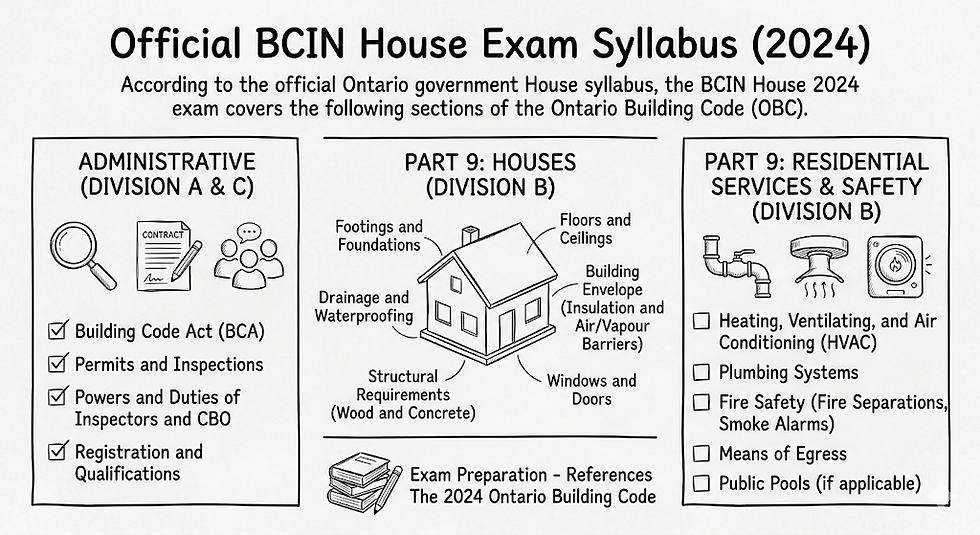
The BCIN House Exam covers the following sections of the Ontario Building Code (OBC) 2024.
Division A – Compliance, Objectives and Functional Statements, as follows:
Part 1 – General:
except 1.3.3.1A. Application of Part 2
except 1.3.3.5.(1)(b), (c), (d), (e), (i), (j) & (k) Designated Structures
Part 2 – Objectives
Part 3 – Functional Statements
Division B – Acceptable Solutions, as follows:
Part 1 – General
Part 3 – Fire Protection, Occupant Safety and Accessibility, only:
3.1. General, only:
3.1.4.7. Heavy Timber Construction
3.1.5.1. Noncombustible Materials
3.1.5.6. Combustible Components for Exterior Walls
3.1.5.15.(2)(e) Foamed Plastic Insulation
3.1.8.4. Determination of Ratings and Classifications
3.1.8.10. Installation of Fire Dampers
3.1.9.4.(4) Combustible Piping Penetrations
3.1.10. Firewalls
3.1.12.1. Determination of Ratings
3.1.13.4. Light Diffusers and Lenses
3.1.20.1. Clearance to Buildings
3.2. Building Fire Safety, only:
3.2.1.1.(1) Exceptions in Determining Building Height
3.2.1.1.(3) Exceptions in Determining Building Height
3.2.1.1.(4) Exceptions in Determining Building Height
3.2.1.1.(5) Exceptions in Determining Building Height
3.2.1.1.(7) Exceptions in Determining Building Height
3.2.1.2. Storage Garage Considered as a Separate Building
3.2.1.3. Roof Considered as a Wall
3.2.1.4. Floor Assembly over Basement
3.2.2.1. Application
3.2.2.3. Exceptions to Structural Fire Protection
3.2.2.5. Applicable Building Height and Area
3.2.2.9. Crawl Spaces
3.2.2.10. Streets
3.2.2.11. Exterior Balconies
3.2.2.12. Exterior Passageways
3.2.2.13. Occupancy on Roof
3.2.2.14. Rooftop Enclosure
3.2.2.18. Automatic Sprinkler System Required
3.2.2.54. Group C, up to 3 Storeys
3.2.3.1. Limiting Distance and Area of Unprotected Openings
3.2.3.2.(1) Area of Exposing Building Face
3.2.3.2.(2) Area of Exposing Building Face
3.2.3.3. Wall Enclosing Attic or Roof space
3.2.3.5. Wall with Limiting Distance Less Than 1.2m
3.2.3.6. Combustible Projections
3.2.3.7. Construction of Exposing Building Face
3.2.3.8. Protection of Exterior Building Face
3.2.3.9. Protection of Structural Members
3.2.3.10.(2) Unlimited Unprotected Openings
3.2.3.12. Area Increase for Unprotected Openings
3.2.3.19.(1) Walkway between Buildings
3.2.3.19.(5) Walkway between Buildings
3.2.3.20. Underground Walkway
3.2.4. Fire Alarm and Detection Systems:
except 3.2.4.1. Determination of Requirement for a Fire Alarm System
except 3.2.4.2.(2) Continuity of Fire Alarm System
except 3.2.4.2.(6) Continuity of Fire Alarm System
except 3.2.4.4.(2) Description of Fire Alarm Systems
except 3.2.4.4.(3) Description of Fire Alarm Systems
except 3.2.4.4.(4) Description of Fire Alarm Systems
except 3.2.4.6.(3) Silencing of Alarm Signals
except 3.2.4.7.(1) Signals to Fire Department
except 3.2.4.7.(2) Signals to Fire Department
except 3.2.4.7.(3) Signals to Fire Department
except 3.2.4.7.(4) Signals to Fire Department
except 3.2.4.8.(6) Annunciator and Zone Indication
except 3.2.4.8.(8) Annunciator and Zone Indication
except 3.2.4.8.(9) Annunciator and Zone Indication
except 3.2.4.9.(2) Electrical Supervision
except 3.2.4.9.(6) Electrical Supervision
except 3.2.4.10. Fire Detectors
except 3.2.4.11. Smoke and Heat Detectors
except 3.2.4.12. Prevention of Smoke Circulation
except 3.2.4.13. Vacuum Cleaning System Shutdown
except 3.2.4.16.(6) Manual Stations
except 3.2.4.16.(7) Manual Stations
except 3.2.4.16.(9) Manual Stations
except 3.2.4.17.(1) Alert and Alarm Signals
except 3.2.4.18.(3) Audibility of Alarm Systems
except 3.2.4.18.(11) Audibility of Alarm Systems
except 3.2.4.18.(13) Audibility of Alarm Systems
except 3.2.4.19. Visible Signals
except 3.2.4.20. Smoke Alarms
except 3.2.4.22. Two-Way Voice Communication Systems
3.2.5.8.(1) Standpipe Systems
3.2.5.9. Standpipe System Design
3.2.5.10.(1) Hose Connections
3.2.5.11. Hose Stations
3.2.5.12. Automatic Sprinkler Systems
3.2.5.13. Combustible Sprinkler Piping
3.2.7.8. Emergency Power for Fire Alarm Systems
3.2.7.10. Protection of Electrical Conductors
3.2.8.1.(1) Application
3.2.8.1.(2) Application
3.3. Safety Within Floor Areas, only:
3.3.1.21. Exhaust Ventilation and Explosion Venting
3.3.1.26. Welding and Cutting
3.4. Exits, only:
3.4.1.6.(1) Restricted Use of Horizontal Exits
3.4.2.5. Location of Exits
3.4.6.10. Horizontal Exits
3.4.7. Fire Escapes
3.5. Vertical Transportation, only:
3.5.3. Fire Separations:
except 3.5.3.1.(2) Fire Separations for Elevator Hoistways
except 3.5.4.1. Elevator Car Dimensions
3.6. Service Facilities, only:
3.6.3. Vertical Service Spaces and Service Facilities:
except 3.6.3.4. Exhaust Duct Negative Pressure
3.7. Health Requirements, only:
3.7.2.1.(1) Window Areas
3.7.4.1. Plumbing and Drainage Systems
3.7.4.2. Plumbing Fixtures, General
3.7.4.5. Plumbing Facilities for Dwelling Units
3.7.4.10. Glazing
3.7.4.11. Surface Protection
3.7.4.12. Floor Drains
3.7.4.13. Grab Bar Installation
3.7.4.16. Water Temperature Control
3.7.4.19. Plumbing Fixtures for Mobile Home Facilities
3.8. Barrier-Free Design, only:
3.8.3.8.(1)(d) Water Closet Stalls and Enclosures
3.8.3.13.(2)(g) Showers and Bathtubs
Part 4 – Structural Design, only:
4.1. Structural Loads and Procedures, only:
4.1.2.1. Loads and Effects
4.1.5.3. Full and Partial Loading
4.1.5.14. Loads on Guards and Handrails
4.1.5.17. Firewalls
4.2. Foundations:
except 4.2.3.8. Steel Piles
except 4.2.3.9. High Strength Steel Tendons
except 4.2.4.2. Subsurface Investigation
except 4.2.4.4. Depth of Foundations
except 4.2.4.7. Dynamic Loading
except 4.2.4.9. Groundwater Level Change
except 4.2.5.1. Design of Excavations
except 4.2.5.2. Excavation Construction
except 4.2.5.3. Supported Excavations
except 4.2.5.4. Unsupported Excavations
except 4.2.5.5. Control of Water Around Excavations
except 4.2.5.6. Loss of Ground
except 4.2.7. Deep Foundations
except 4.2.8. Special Foundations
4.3. Design Requirements for Structural Materials
Part 5 – Environmental Separation:
except 5.4. Air Leakage
except 5.7. Surface and Ground Water
except 5.8. Sound Transmission
Part 6 – Heating, Ventilating and Air- Conditioning, only:
6.2. Design and Installation, only:
6.2.1.5.(1) Installation Standards
6.3. Ventilation Systems, only
6.3.2.9. Supply, Return, Intake and Exhaust Air Openings
6.3.2.10.(7) Exhaust Ducts and Outlets
Part 7 – Plumbing, only:
7.1. General, only:
7.1.2.1. Sanitary Drainage Systems
7.1.2.2. Storm Drainage Systems
7.2. Materials and Equipment, only:
7.2.10.7B. Showers
7.4. Drainage Systems, only:
7.4.10.4. Hydraulic Loads from Roofs or Paved Surfaces
7.6. Potable Water Systems, only:
7.6.1.7. Relief Valves
7.6.4. Water Efficiency
Part 9 – Housing and Small Buildings, only:
9.1. General, only:
9.1.1.1. Application
9.1.1.5. Proximity to Existing Above Ground Electrical Conductors
9.1.1.7. Radon
9.1.1.8. Building in Flood Plains
9.1.1.9. Site Assembled and Factory-Built Buildings
9.3. Materials, Systems and Equipment
9.4. Structural Requirements
9.5. Design of Areas, and Spaces and Doorways:
except 9.5.2.2. Protection on Floor Areas with a Barrier- Free Path of Travel
except 9.5.3D.5. Recreational Camps
except 9.5.3D.6. Camps for Housing Workers
except 9.5.5.2. Doors to Public Water Closet Rooms
9.6. Glass:
except 9.6.1.4.(4) Types of Glass and Protection of Glass
except 9.6.1.4.(5) Types of Glass and Protection of Glass
9.7. Windows, Doors and Skylights
9.8. Stairs, Ramps, Handrails and Guards:
except 9.8.1.4. Escalators and Moving Walks
except 9.8.5.1.(2) Application
except 9.8.6.1.(2) Application
except 9.8.8.1.(8) Required Guards
except 9.8.8.4. Guards for Floors and Ramps in Garages
9.9. Means of Egress:
except 9.9.2.6. Exterior Exit Stairs that Serve a Hotel
except 9.9.4.7. Stairways in Group D or E Buildings
except 9.9.5.2. Occupancies in Corridors
except 9.9.6.4.(2) Door Action
except 9.9.6.4.(3) Door Action
except 9.9.6.4.(4) Door Action
except 9.9.6.5.(1.1) Direction of Door Swing
except 9.9.6.5.(2) Direction of Door Swing
except 9.9.6.5.(3) Direction of Door Swing
except 9.9.6.5.(4) Direction of Door Swing
except 9.9.8.2.(3) Number of Required Exits
except 9.9.8.5. Exiting through a Lobby
except 9.9.8.6. Mezzanine Means of Egress
except 9.9.11.3. Exit Signs
9.10 Fire Protection:
except 9.10.1.3.(2) Items Under Part 3 Jurisdiction
except 9.10.2.3. Major Occupancies above Other Major Occupancies
except 9.10.2.4. Buildings Containing More Than One Major Occupancy
except 9.10.8.8.(2) Floors of Exterior Passageways
except 9.10.9.5. Interconnected Floor Spaces
except 9.10.9.15. Separation of Suites
except 9.10.9.17.(2) Separation of Public Corridors
except 9.10.9.17.(3) Separation of Public Corridors
except 9.10.9.19.(2) Separation of Repair Garages
except 9.10.9.19.(4) Separation of Repair Garages
except 9.10.10.5. Incinerators
except 9.10.13.10.(2) Self- Closing Device
except 9.10.17.7. Corridors Containing an Occupancy
except 9.10.17.8. Light Diffusers and Lenses
except 9.10.18.4.(4) Rooms and Spaces Requiring Heat Detectors or Smoke Detectors
except 9.10.18.6. Portions of Buildings Considered as Separate Buildings
except 9.10.18.8. Open-Air Storage Garages
except 9.10.18.9. Fire Alarm System in a Hotel
except 9.10.20.4. Portable Extinguishers
except 9.10.20.5. Freeze Protection for Fire Protection Systems
except 9.10.21. Fire Protection for Construction Camps
9.11. Sound Transmission
9.12. Excavation
9.13. Dampproofing, Waterproofing and Soil Gas Control
9.14. Drainage
9.15. Footings and Foundations
9.16. Floors-On-Ground
9.17. Columns
9.18. Crawl Spaces
9.19. Roof Spaces
9.20. Masonry and Insulating Concrete Form Walls Not in Contact with the Ground
9.21. Masonry and Concrete Chimneys and Flues
9.22. Fireplaces
9.23. Wood- Frame Construction
9.24. Sheet Steel Stud Wall Framing
9.25. Heat transfer, Air Leakage and Condensation Control
9.26. Roofing
9.27. Cladding
9.28. Stucco
9.29. Interior Wall and Ceiling Finishes
9.30. Flooring
9.31. Plumbing Facilities:
except 9.31.1.1.(2) Application
except 9.31.1.1.(3) Application
9.33. Heating and Air-Conditioning, only:
9.33.6.14A.(3) Exhaust Ducts and Outlets
9.34. Electrical Facilities:
except 9.34.1.5. Wiring and Cables
9.35. Garages and Carports
9.37. Cottages
9.38. Log Construction
9.39. Park Model Trailers
9.40. Reinforced Concrete Slabs
9.41. Additional requirements for Change of Use
Part 11 – Renovation, only:
11.5. Compliance Alternatives, including Compliance Alternatives listed in Tables
Tables 11.5.1.1.C which cross-reference requirements in the remainder of the “House” syllabus
Part 12 – Resource Conservation and Environmental Integrity, only:
12.1. General
12.2. Energy Efficiency, Carbon Dioxide Equivalents and Peak Electric Demand:
except 12.2.1.2.(2) Energy Efficiency Design
except 12.2.1.2.(4) Energy Efficiency Design
except 12.2.2.1.(1) Carbon Dioxide Equivalents
except 12.2.3.1.(1) Peak Electric Demand
12.3. Energy Efficiency for Buildings of Residential Occupancy Within the Scope of Part 9
12.4. Water Efficiency
Division C – Administrative Provisions, only:
Part 1 – General, only:
1.1.1.2. Conformance with Administrative Requirements
1.2.1.1.(1) Application
1.3. Permits and Inspections, only:
1.3.1.5. Conditional Permits
1.3.2.1. Permit Posting
1.3.2.2. Documentation on Site
1.3.3.2. Conditions for Residential Occupancy
1.3.3.3. Notification
1.3.3.4. Occupancy Permit – Certain Buildings of Residential Occupancy
1.3.5.1.(1) Prescribed Notices
1.3.5.1.(2)(a) to (i), (o) and (p) Prescribed Notices
1.3.5.2. Additional Notices
1.3.6.1. Application
Part 2 – Alternative Solutions, Disputes, Rulings and Interpretations, only:
2.1. Alternative Solutions
2.4. Rulings and Interpretations
Supplementary Standards
The following Supplementary Standards may be covered in the exam:
Supplementary Standard SA-1 – Objectives and Functional Statements Attributed to the Acceptable Solutions
Supplementary Standard SB-1 – Climatic and Seismic Data
Supplementary Standard SB-2 – Fire Performance Ratings
Supplementary Standard SB-3 – Fire and Sound Resistance Tables
Supplementary Standard SB-7 – Guards for Housing and Small Buildings
Supplementary Standard SB-9 – Requirements for Soil Gas Control
Supplementary Standard SB-12 – Energy Efficiency for Housing
Frequently Asked Questions (FAQs)
1. What topics should I actually focus on for the BCIN House exam?
Most candidates should focus heavily on:
Part 9
Stairs and guards
Fire separations
Spatial separation
SB-12 energy efficiency
Framing tables
Windows and egress requirements
These topics appear very frequently in the exam and in real residential design work.
2. Is the BCIN House exam mostly based on Part 9?
Yes. The BCIN House exam is mainly focused on Part 9 – Housing and Small Buildings. Most questions come from residential construction requirements related to houses, basements, additions, and small buildings.
3. Do I need to study the entire Ontario Building Code?
No. One of the biggest mistakes students make is trying to study the entire OBC. The exam follows the official syllabus and focuses only on selected sections of the code.
4. Is the BCIN House exam open book?
Yes. The exam is open book, which means knowing how to navigate the Ontario Building Code quickly is often more important than memorizing everything.
5. Is SB-12 important for the BCIN House exam?
Absolutely. SB-12 is one of the most important sections in the BCIN House exam. Many students struggle with energy efficiency packages, window U-values, and compliance paths.
6. Does the BCIN House exam include Part 3?
Only limited Part 3 sections are included. The exam is still mainly a Part 9 exam. Learning how to recognize and avoid irrelevant Part 3 content can save a lot of time during the test.
7. What is the hardest part of the BCIN House exam?
Most students find these topics challenging:
SB-12 calculations
Spatial separation
Fire protection
Stair requirements
Structural span tables
The difficulty usually comes from navigating the code under time pressure.
8. How long should I study before taking the BCIN House exam?
It depends on your background, but many candidates prepare for:
60 days (full-time study)
120 days (part-time study)
180 days (working professionals)
Consistency matters more than studying long hours occasionally.
9. Can I pass the BCIN House exam without construction experience?
Yes. Many students, immigrants, and career changers pass the BCIN House exam without prior Canadian construction experience by learning:
Ontario Building Code navigation
Exam strategy
Real exam-style questions
10. What is the best way to prepare for the BCIN House exam?
The best preparation strategy is:
Study the official syllabus
Focus mainly on Part 9
Practice code navigation daily
Solve realistic practice questions
Learn how exam questions are structured
Strong code navigation skills can make a major difference in your exam performance.


Comments