
Why the General Legal BCIN Should Always Be Your First BCIN Exam (Whether You Want a Government Job or Your Own Design Business)

If you're planning to write your first BCIN exam, you're probably asking one question:
"Which BCIN exam should I take first?"
Some people will tell you to start with the BCIN House exam.
Others recommend Designer Legal.
But if your goal is to build the largest number of career opportunities, the answer is surprisingly simple.
Start with the General Legal/Process BCIN Exam.
Whether you want to:
Become a Building Inspector
Work as a Plan Examiner
Get a municipal government job
Open your own design business
Stamp drawings as an independent BCIN designer
Eventually write House, Small Buildings, or Large Buildings
General Legal is the foundation that unlocks almost every career path.
Why Most Students Make the Wrong Decision
One of the biggest mistakes students make is studying technical code before understanding how the building permit system actually works.
Many candidates immediately jump into:
House
Small Buildings
Plumbing
HVAC
They spend months learning construction requirements...
But they don't fully understand:
Who is legally responsible?
Who can design?
Who reviews permits?
How compliance works?
What happens when mistakes are made?
What authority municipalities have?
The General Legal exam teaches the framework behind every technical BCIN qualification.
Think of it this way:
Technical BCIN exams teach you "how to design." General Legal teaches you "how the entire system works."
The Building Industry Runs on Law Before Construction
Most people think building construction starts with concrete.
It doesn't.
It starts with legislation.
Every permit...
Every inspection...
Every order...
Every occupancy approval...
Every designer...
Every inspector...
Every municipality...
operates under the Building Code Act and the Ontario Building Code.
That is exactly what the General Legal exam teaches.

General Legal knowledge is required across the entire process.
Career Path #1: Government Jobs
One reason the General Legal qualification is so valuable is that it aligns with the knowledge needed for many municipal building department roles.
Examples include:
Plans Examiner
Building Official
Permit Technician (depending on municipality)
Building Department support roles
These jobs focus heavily on:
legislation
permit processes
legal responsibilities
enforcement
inspections
compliance
General Legal gives you the legal framework that supports these responsibilities.
Important: Municipal employers set their own hiring requirements. Having the General Legal qualification alone does not guarantee a government job, but it is a common foundational qualification for many building department career paths.
Career Path #2: Independent BCIN Designer
Many students dream of opening their own residential design business.
Eventually, they want to:
✔ Design houses
✔ Design legal basement (second suite)
✔ Submit permit drawings
✔ Sign their own drawings
✔ Work independently
But here's what many people misunderstand...
The legal qualification is part of becoming a registered designer.
For most residential design work, you need:
an appropriate technical qualification (for example, House)
the applicable legal qualification
registration with the Ministry
Without the appropriate legal qualification, your technical qualification alone is generally not enough to practice as a registered designer for work that requires registration.

Why General Legal Makes Every Other BCIN Exam Easier
Once you understand:
Permit process
Responsibilities as per the roles
Building Code Act
Compliance
Legal terminology
How to read syllabus
How to use building code
Exam strategies
Every technical BCIN exam begins to make much more sense.
Instead of memorizing rules...
You understand why the rules exist.
Students who begin with General Legal often have a stronger understanding of the broader regulatory system before moving into technical design topics.
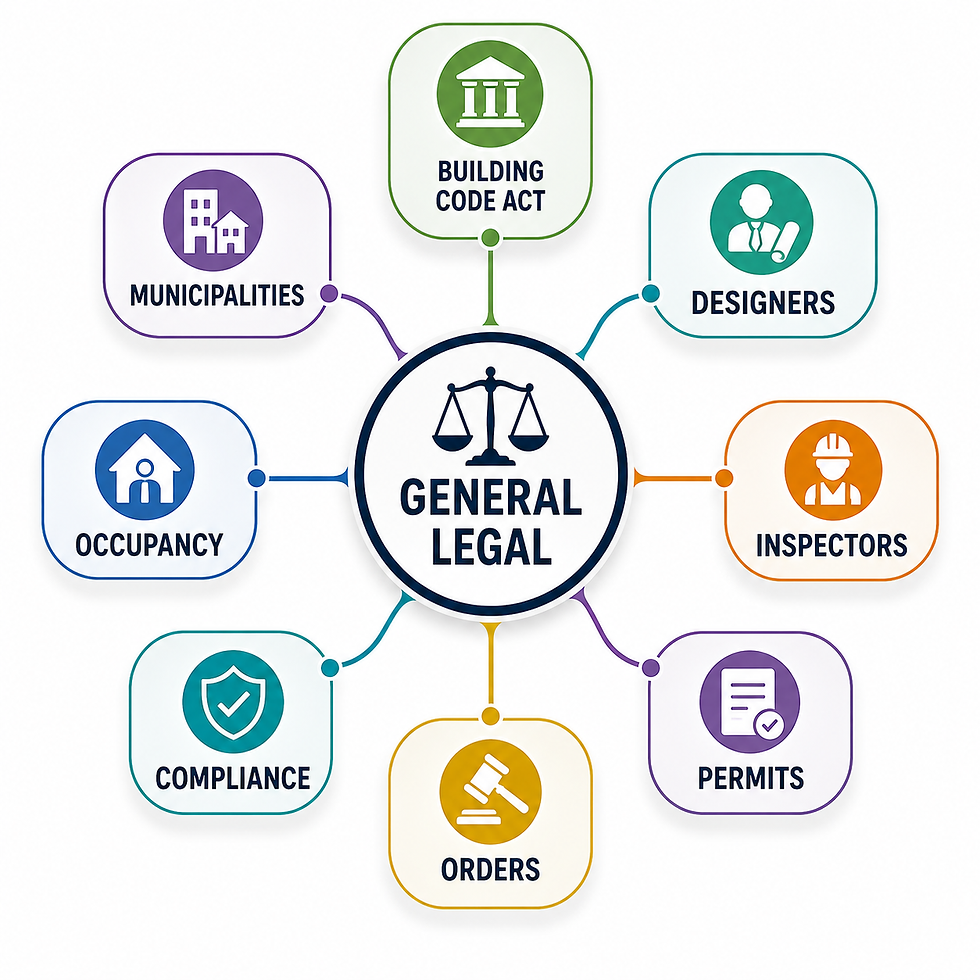
What You'll Learn in the General Legal BCIN Exam
The exam is not about structural calculations.
Instead, it focuses on topics such as:
Building Code Act
Building Code administration
Permit applications
Responsibilities of designers
Responsibilities of builders
Responsibilities of owners
Powers and duties of inspectors
Orders
Inspections
Compliance
Occupancy
Enforcement
Legal liability
Building permits
Alternative solutions
Administrative processes
"Should I Take BCIN House First?"
This is one of the most common questions.
The answer depends on your career goals.
If you only want to learn house construction, you may choose to start with House.
However, if your goal is to build a long-term career in Ontario's building industry—including municipal work, independent design, or eventually multiple BCIN qualifications—starting with General Legal gives you a strong understanding of the legal and administrative framework that applies across the system.
General Legal vs Designer Legal
Many students confuse these two exams.
General Legal/Process | Designer Legal/Process |
Broader legal framework | Focused on designer obligations |
Valuable foundation for municipal and industry knowledge | Required legal qualification for many registered designers |
Covers inspections, enforcement, permits, legislation | Concentrates on legal responsibilities of designers |
Good starting point for understanding the system | Usually paired with technical design qualifications |
Real Career Examples
Future Building Inspector

Future Plan Examiner

Career roadmap

Frequently Asked Questions
Can I get a government job with only the General Legal BCIN?
General Legal is an excellent foundational qualification, but most Building Inspector and Plan Examiner positions require additional technical qualifications and/or relevant experience. Requirements vary by municipality.
Can I stamp house drawings with only the General Legal BCIN?
Yes. General Legal alone does not authorize you to design or sign house permit drawings. You also need the appropriate technical qualification (such as House), the applicable legal qualification for registration, and registration with the Ministry, insurance, depending on the scope of work.
Is General Legal easier than the House exam?
Yes. Many students find General Legal less technical because it focuses on legislation, processes, and responsibilities rather than construction details.
Which exam should I take after General Legal?
A common next step is:
House (for residential designers)
Small Buildings (for broader building design - Complex exam - Not Recommanded directly before house)
Building Services
Plumbing All Building
Large Buildings
Choose based on your career goals or email us on info@stonewoodpartners.ca and we'll guide you.
Final Thoughts
The General Legal BCIN exam is more than just another qualification—it provides the legal and administrative foundation for understanding Ontario's building regulatory system.
Whether your ambition is to:
work in a municipal building department,
become an independent residential designer,
pursue multiple BCIN qualifications, or
better understand the Building Code Act and permit process,
starting with General Legal can make the rest of your BCIN journey much easier.
The strongest careers in Ontario's building industry are built on both technical knowledge and a solid understanding of the legal framework that governs every permit, inspection, and design.


Comments